Environment and our operations
Biodiversity, Water, Forestry, Sustainable agriculture
Biodiversity
We believe that people's lives, society, corporate activities, and the activities of all people are part of the ecosystem. In the “Living with the planet,” we aim to preserve the healthy relationship between nature and people and companies by improving the impact of our activities on the ecosystem.
In the JT Group Sustainability Targets, each of the JT Group businesses will perform assessments to evaluate its impact and dependency on ecosystem, including biodiversity aspects. Impact assessment of our tobacco business will be performed by 2024, and our processed food business by 2025.
Read more about the JT Group Sustainability Targets and 2025 Results.
We endorsed the Declaration of Biodiversity by Keidanren, which is an ambitious action guideline that summarizes specific biodiversity-related activities in Japan.
Please see the JT Group Biodiversity Statement for more on our commitment and ambitions.
Biodiversity impact assessment
In 2022, we conducted an initial risk assessment of our impact and dependency on biodiversity for our tobacco business, with reference to TNFD v0.3 and the International Union for Conservation of Nature’s (IUCN) guidelines. In 2024, we conducted a biodiversity impact assessment for our tobacco business, based on Science Based Targets Network (SBTN*1) analysis methodology. Since ecosystems depend considerably on regional characteristics, we use this methodology to develop scientifically grounded action plans tailored to each identified target area, and pursue initiatives accordingly. This enables us to better understand our tobacco business's relationship with Nature, in terms of impact and dependency, to prioritize areas and regions for intervention.
In 2025, we sought to enhance the biodiversity impact assessments of the tobacco business conducted in 2024, expanding the scope and enhancing the analysis using geographic information systems and SBTN methodology. In addition, we also looked at the processed food business, conducting biodiversity impact assessments of activity bases and major production areas for key raw materials. This provided us with a comprehensive understanding of the mutual impacts and dependences of our manufacturing sites and ecosystems in each business with respect to the atmosphere, natural resources, soil, and other aspects. In addition, we identified potential risks in our value chain arising from those mutual relationships, while at the same time confirming that those risks were being appropriately managed through existing initiatives related to “Living with the planet.”
Looking across the insights gained through these initiatives reaffirmed for us that individual themes including climate change, water resources, forest resources, and biodiversity are mutually connected through ecosystems. Going forward, we will treat these themes as wide-ranging sustainability issues that are interrelated through ecosystems, rather than as individual themes, and strive to take a more integrated and comprehensive approach to considering and conducting measures.
Read more about biodiversity on the JT international website.
Protecting water
Societal demand for water is increasing globally and water-related issues such as availability, quality, flooding, drought, or regulatory changes can have a major impact on society and our business.
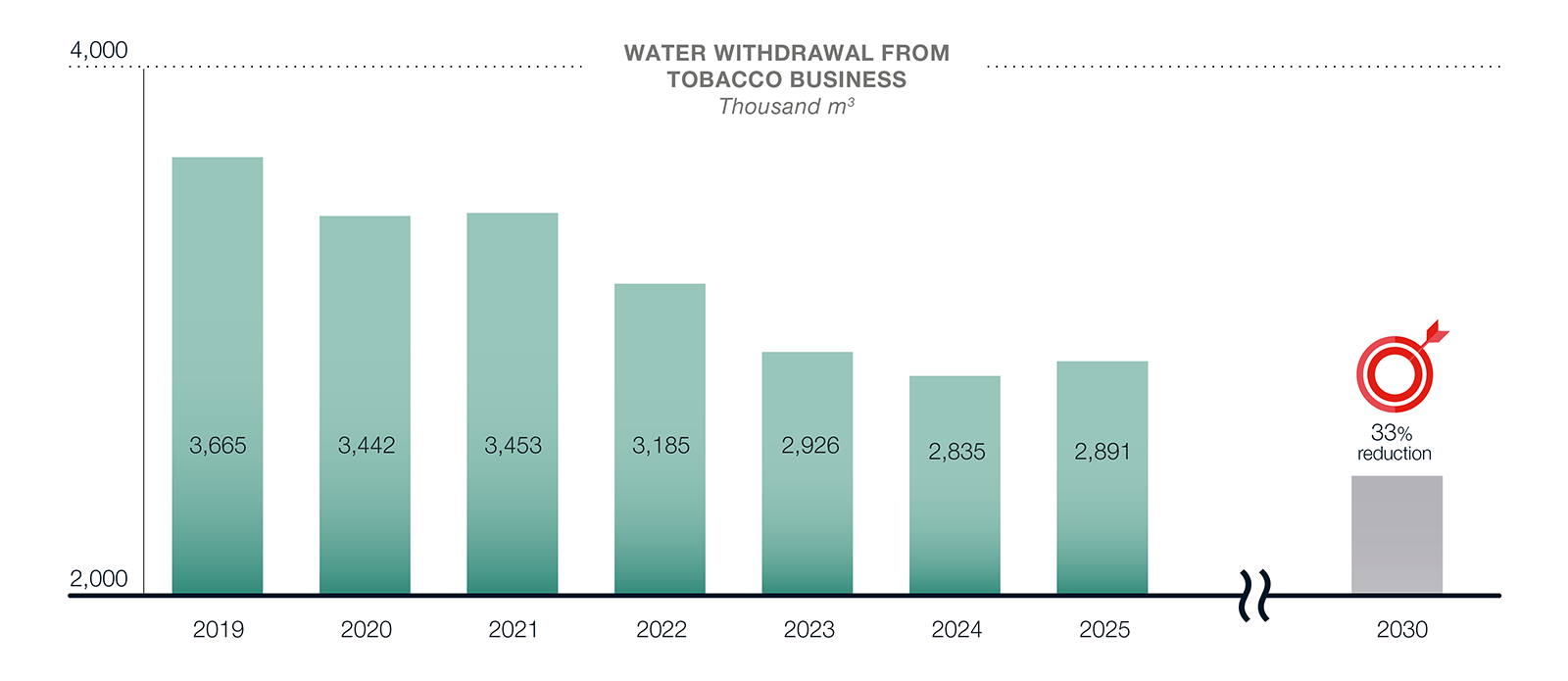
In the JT Group Sustainability Targets, we commit to supporting global water stewardship by reducing our water withdrawal in our tobacco business’s operations by 33% by 2030 against a 2019 base year, and our tobacco business will have 100% of its eligible production facilities certified against the Alliance for Water Stewardship (AWS)*2 standard by 2030.
As part of our approach to good water stewardship, we committed to carrying out water risk assessments at 100% of our factories. In 2020, we completed the first risk assessments at all of our factories, and we are continuously working on a program of reassessments including our suppliers. Our water risk assessments consider water availability and quality, changing legislation, natural disasters such as floods and drought, and future water stress. From the assessments, we develop action plans to reduce risk and improve overall water management and security.
In 2025, we made efforts to improve water recycling rates at tobacco factories in 13 countries, including Japan. We also worked to improve our water treatment processes in Turkey, the Philippines, and Bangladesh. These efforts yielded a 21% reduction in water withdrawal in our tobacco business’s operations compared with 2019. In addition, our factory in Torbali, Turkey became the first tobacco factory in the JT Group to receive AWS certification.
We will work to improve water resource management through the acquisition of AWS certification and we will also work in collaboration with stakeholders to promote further water conservation and stewardship.
Read more about water stewardship on the JT international website.
Progress toward quantitative targets
By the end of 2025, we reduced water use associated with our tobacco business by 21% from 2019 through our initiative for efficient water use.
Water stewardship in our supply chain
Water, as part of our Environmental Stewardship approach, is a critical component of sustainable tobacco production. Environmental stewardship means managing tobacco farming in a way that protects natural resources, prevents environmental harm, and strengthens the long-term resilience of farming systems and surrounding landscapes. Daily agronomic and operational decisions at farm level directly influence soil health, water resources, biodiversity, forests, land use, and climate impacts.
Within this context, water is recognized as a finite and shared natural resource. Through direct engagement with contracted tobacco growers throughout the crop season, and through the implementation of our Good Agricultural Practices (GAP) and Minimum Agronomic Standards (MAS) we promote agronomic practices that:
- improve water-use efficiency,
- enhance soil and water conservation,
- protect surface and groundwater quality,
- reduce risks in water-stressed areas, and
- contribute to the long-term resilience of farming systems and surrounding landscapes.
Beyond directly contracted growers, we also engage with third-party leaf suppliers through our Sustainable Tobacco Program (STP), promoting sustainable agricultural practices, including responsible water stewardship and water use improvement.
More broadly, environmental expectations are embedded in the JTI Supplier Standards, which recommend that suppliers:
- implement environmental management systems aligned with internationally recognized standards, such as ISO 14001,
- identify and appropriately manage environmental risks and impacts within their own operations and supply chains,
- protect surface and groundwater quality,
- minimize the use of natural resources including water, and
- monitor and minimize emissions and discharges to air, water and land.
To better understand and manage water-related risks across our supply chain, the tobacco business assesses water-related risks and dependencies using internationally recognized tools such as WRI Aqueduct and integrates these considerations into its supplier screening and ESG risk management processes. In 2025, 100% of our key suppliers have been assessed against ESG criteria.
These efforts contribute to measurable improvements in water efficiency. Between 2019 and 2024, water abstraction intensity within our tobacco leaf supply chain decreased by 4%, demonstrating the positive impact of supplier engagement and sustainable agricultural practices.
Forestry
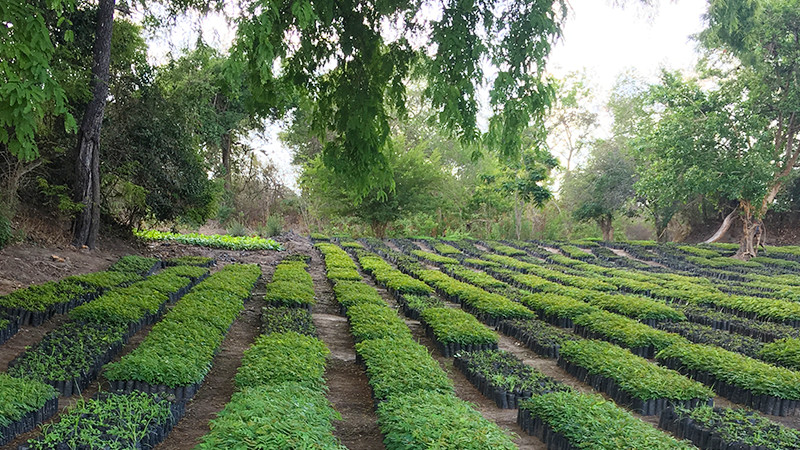
The paper used in our products and the wood used as fuel in the tobacco curing process are important resources for our tobacco business. The JT Group considers initiatives to sustainably secure forestry resources in its supply chain to be of crucial importance, also for the sake of increasing biodiversity, and has cited “Enhancing biodiversity — No deforestation, no conversion” as one of the JT Group Sustainability Targets.
Our specific target is to eliminate deforestation of natural forests in the tobacco business’s own operations and supply chains for tobacco leaf, paper and pulp-based materials by 2025 and in our entire supply chain by 2030. Furthermore, we are aiming to eliminate conversion of natural ecosystem in high conservation value areas by 2025 and all natural lands by 2030. Furthermore, we will work toward zero net deforestation of managed natural forests in the entire tobacco business supply chain by 2030.
Read more about forestry on the JT international website.
Progress toward qualitative targets
We have been working toward achieving zero deforestation of natural forests throughout our tobacco business supply chain. In 2025, we conducted a deforestation risk assessment for our tobacco leaf, paper, and pulp-based material supply chains, confirming that 94% of tobacco leaf procured from directly contracted growers and 80% of globally procured paper and pulp-based material originate from areas with low deforestation risk. Looking ahead, we will promote more comprehensive risk assessment and management, including tobacco leaf procurement from third-party suppliers and locally procured paper and pulp.
In addition, we also discussed and developed monitoring methods to achieve zero conversion of natural ecosystems in the tobacco leaf, paper, and pulp-based material supply chains in our tobacco business. Our next steps include expanding the scope of deforestation risk assessment and advancing our monitoring methods.
We are currently developing rigorous calculation methods for achieving zero net deforestation of managed forests throughout our tobacco business supply chain. With these methods, even when logging is conducted in managed forests, we will aim to conduct verified, community-based regeneration activities and sustainable forest management.
Sustainable agriculture
In the tobacco business, tobacco leaf is an essential raw material. One of our JT Group Sustainability Targets is “sustainable agriculture,” including initiatives regarding agrichemicals, which have an undeniable impact on ecosystems.
As set in the JT Group Sustainability Targets, the JT Group's directly contracted tobacco leaf growers will eliminate the use of Criterion 1 HHPs by 2024, and all HHPs by 2040. By 2030, 100% of our directly contracted growers will have adopted our Good Agricultural Practices (GAP) Protocol.
Progress toward quantitative targets
As of the end of 2024, all of our directly contracted growers eliminated the use of class I Highly Hazardous Pesticides (HHPs) as planned. We will promote ongoing initiatives with directly contracted growers to completely eliminate the use of HHPs. Moreover, as of the end of 2025, the ratio of directly contracted growers implementing our Good Agricultural Practices (GAP) Protocol reached 84.9%.
Read more about sustainable agriculture on the JT international website.
- *1 SBTN: An international organization comprised mainly of non-profit organizations and economic organizations that develops methodology for scientific targets and activities in the five domains of water, land, oceans, biodiversity, and climate in order to conserve the natural environment and reduce environmental impacts.
- *2 AWS: Alliance for Water Stewardship is a global membership collaboration comprising businesses, NGOs and the public sector. Its members contribute to the sustainability of local water-resources through their adoption and promotion of a universal framework for the sustainable use of water - the International Water Stewardship Standard, or AWS Standard - that drives, recognizes and rewards good water stewardship performance.
- Biodiversity : The variety of life forms, ecosystems, and genetic diversity within nature.
- Biodiversity Impact Assessment : An assessment of a business’s impacts and dependencies on biodiversity and ecosystems.
- TNFD : Taskforce on Nature-related Financial Disclosures, a framework for nature-related risk and opportunity reporting.
- SBTN : Science Based Targets Network, an organization that develops science-based methods for environmental target setting.
- Ecosystem : A network of living organisms and their physical environment interacting as a system.