Corporate governance forms the foundation supporting the JT Group’s growth. Through systems that enhance management effectiveness and transparency, we aim to ensure sustainable growth.
Corporate governance structure
Basic policy
The JT Group believes that corporate governance is a framework for transparent, fair, timely and decisive making in pursuit of the 4S model, our management principle. Pursuing the 4S model means striving to fulfill responsibilities to our valued consumers, shareholders, employees and wider society, carefully considering respective interests of these key stakeholder groups, and exceeding their expectations wherever we can.
We have established the JT Corporate Governance Policy in recognition that improvement in corporate governance is conducive to sustainable profit growth and corporate value over the medium- to long-term, and benefits stakeholders and, in turn, helps to move the economy and society forward.
We will endeavor to continuously enhance our corporate governance as a key management priority.
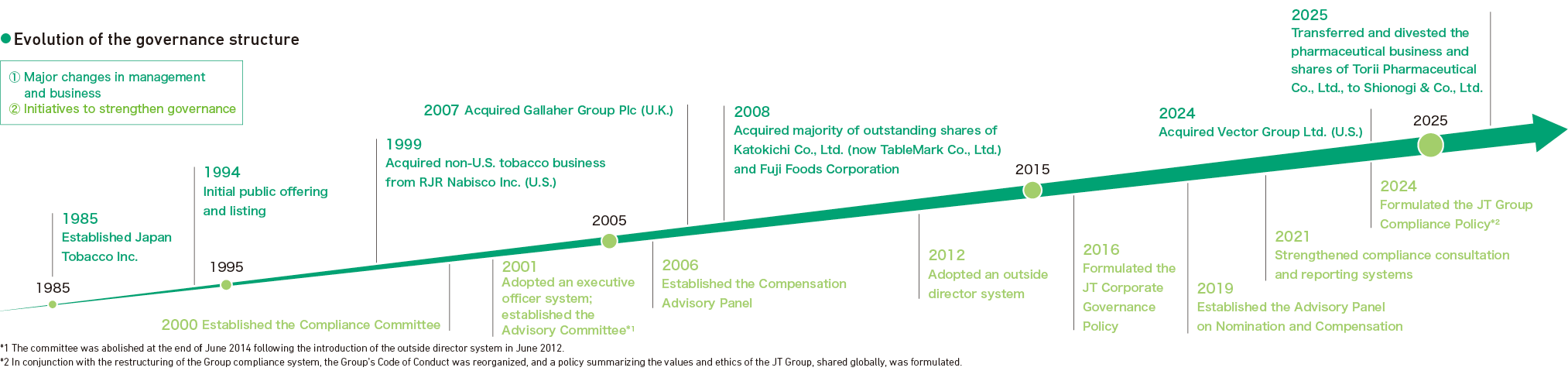
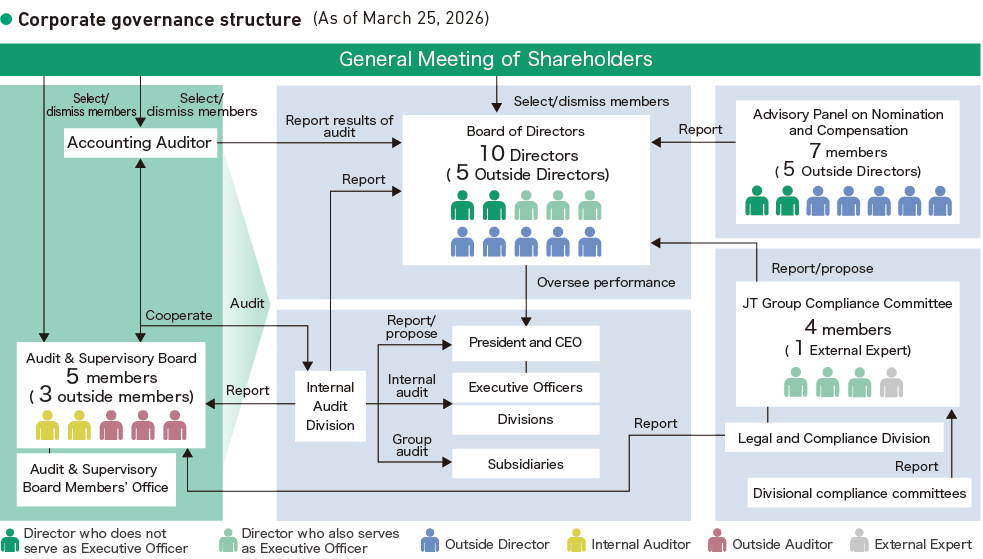
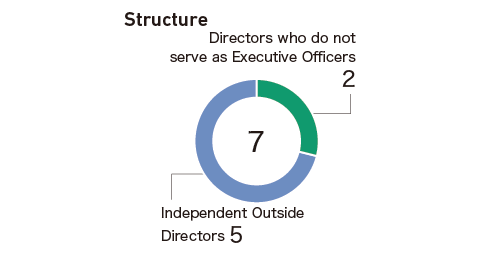
We are strengthening objective and impartial management oversight functions by positioning an independent and fair Audit & Supervisory Board that appropriately oversees the duties of Executive Officers and Members of the Board (hereinafter Directors). We have also streamlined our Board of Directors and expedited operational execution by delegating authority to Executive Officers, while establishing, on a voluntary basis, the JT Group Compliance Committee and the Advisory Panel on Nomination and Compensation. The former comprises the President and Chief Executive Officer (hereinafter CEO), Executive Vice Presidents and an outside expert; the latter consists entirely of Directors who do not serve as Executive Officers, and more than half the members are Independent Outside Directors. We have built an effective corporate governance regime.
We continuously seek to improve corporate governance and increase management transparency and objectivity through, for instance, the appointments of an additional Outside Director and Outside Audit & Supervisory Board Member in March 2019, an additional Outside Director in March 2022, and an additional Outside Director in March 2024.
Through such measures, we have adopted our current corporate governance regime as we believe it functions effectively with respect to operational execution and oversight.
Corporate governance structure
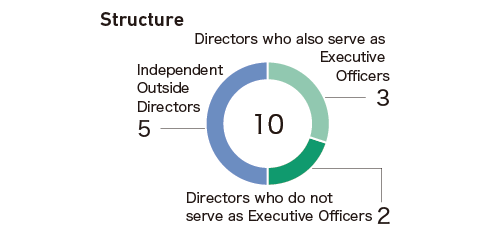
An overview of the corporate governance structure of the Company is shown below.
Board of Directors
The Board of Directors is the body responsible for determining JT Group management strategies and key issues, and for overseeing all business activities. Board of Directors meetings take place once a month in principle and additionally as needed in a timely manner, in order to make decisions on important matters, including those specified by laws and regulations, to supervise business execution, primarily through reports on the status of business execution.
Chairman: Shigeaki Okamoto (Chairman of the Board) Number of meetings: 17 in FY2025
Key matters discussed (FY2025):
Important matters such as formulation of management plans, appointment of Executive Officers, and withdrawal from the pharmaceutical business through its transfer
Progress on financial results, financial matters, and sustainability strategies
Matters related to Group compliance, risk management, and internal control
Matters related to the evaluation of the effectiveness of the Board of Directors and the Advisory Panel on Nomination and Compensation
Advisory Panel on Nomination and Compensation
The Advisory Panel on Nomination and Compensation deliberates on matters related to executive appointments and remuneration, and reports its recommendations to the Board of Directors.
Based on these recommendations, the Board of Directors deliberates on these matters, thereby further enhancing the objectivity and transparency of its decision-making and strengthening its oversight functions.
Chairman: Tetsuya Shoji (Independent Outside Director) Number of meetings: 4 in FY2025
Key matters discussed (FY2025):
Selection of candidates for the Board of Directors and discussions on the skills matrix
Discussions regarding the selection of peer companies for benchmarking remuneration levels, etc.
Confirmation of remuneration levels
Review of executive candidate pool
Discussions regarding key performance indicators for executive bonuses and performance share units
Audit & Supervisory Board
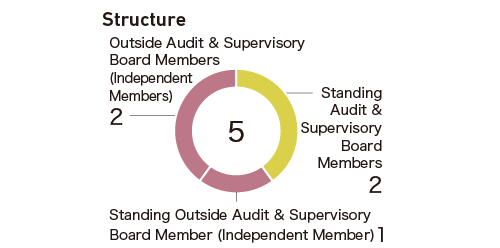
The Audit & Supervisory Board consists of five Audit & Supervisory Board Members with extensive experience in management, law, finance, accounting and other fields. The Audit & Supervisory Board conducts operational and accounting audits and actively exercises its authority as an independent body entrusted by shareholders, including attending and speaking at Board of Directors and other important meetings, as well as actively inspecting business sites. In addition, it conducts audits appropriately from an objective viewpoint in accordance with the respective roles of the Outside/Standing Audit & Supervisory Board Members.
Chairman: Hideaki Kashiwakura (Standing Audit & Supervisory Board Member) Number of meetings: 14 in FY2025
Key matters discussed (FY2025):
Discussion and preparation of audit policies
Discussion and preparation of Audit & Supervisory Board audit reports
Evaluation of the effectiveness of the Board of Directors
The Company evaluates the effectiveness of the Board of Directors annually through a self-assessment questionnaire completed by all Directors and Audit & Supervisory Board Members, covering areas such as the Board’s operational structure, oversight functions, and dialogue with shareholders and investors. The results are compiled, and the Board of Directors reviews and analyzes these results while addressing the issues identified.
Evaluation of effectiveness in FY2025
Evaluation items for the FY2025 questionnaire
The evaluation was conducted for a total of 15 Directors and Audit & Supervisory Board Members, covering the period from January to December 2025. In addition to items that should be continuously monitored, the questionnaire was designed to confirm improvements in issues identified in the fiscal 2024 evaluation. In addition, we designed questions to capture expectations regarding the establishment of a medium- to long-term governance structure and, from 2025, introduced new questions related to the individual evaluation of Outside Directors.
Based on responses to the questionnaire items, the results were discussed at the Board of Directors meeting held in February 2026.
Evaluation items for the FY2025 questionnaire
As in fiscal 2024, the Board effectiveness evaluation for fiscal 2025 yielded generally positive results across all evaluation items, confirming that the Board’s effectiveness continues to improve and that it is operating effectively. In particular, high evaluations were given for the Board’s understanding of stakeholder perspectives, its shared understanding of the 4S model as a common value framework, and its appropriate oversight of the risk management system.
In addition, the initiatives undertaken to address issues identified in the fiscal 2024 effectiveness evaluation were positively assessed, and continued efforts in these areas are expected. The Board will continue its deliberations and pursue further enhancement to improve its effectiveness on an ongoing basis.
We will continue to implement the necessary improvements, including the above-mentioned initiatives, with the aim of further improving effectiveness.
Development of next-generation management talent and succession planning
The Company recognizes that the continuous development of next-generation management talent to lead the future of the Group, as well as the qualitative and quantitative expansion of the candidate pool, is one of its key management priorities.
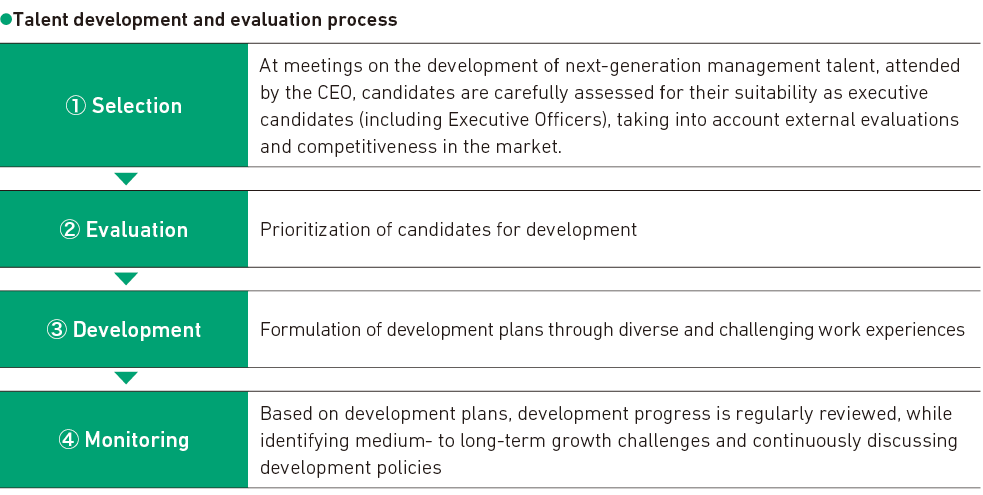
In order to continuously develop leaders with the capabilities and qualities required to operate on a global basis, the Company is undertaking systematic selection and development initiatives under the strong commitment of senior management, led by the CEO.
In addition, for individuals recognized as potential candidates for Directors and Audit & Supervisory Board Members, the Advisory Panel on Nomination and Compensation reviews their development status and discusses the enhancement of succession planning, while leveraging external perspectives such as those of Independent Outside Directors and external experts.
Specific initiative: JT-Next Leaders Program (NLP)
The Company implements NLP with the aim of continuously developing young top management talent to lead the Group’s operations both in Japan and overseas.
Launched in fiscal 2013, the program targets employees aged 40 or younger who meet the eligibility criteria. Candidates are selected through an objective process that combines multiple assessments, including interviews conducted by executives and external interviewers. Those selected receive prioritized development support over several years to foster their growth.
Through these initiatives, the Company is strengthening its management talent pool from a younger generation and enhancing the competitiveness of its talent.
Executive remuneration
Executive remuneration policy
The Board of Directors establishes policies on executive remuneration, including the method for determining individual remuneration for Directors. To ensure independence and objectivity, these policies are determined by the Board based on deliberations and recommendations by the Advisory Panel on Nomination and Compensation, which is composed entirely of Directors who do not serve as Executive Officers, with a majority being Independent Outside Directors.
Based on these policies, the Company’s basic approach to executive remuneration is as follows:
Set remuneration at a level appropriate to attract and retain highly capable personnel
Implement a performance-linked remuneration system that incentivizes the achievement of business results
Align remuneration with the Company’s medium- to long-term corporate value
Ensure transparency through objective and quantitative frameworks
Composition of executive remuneration
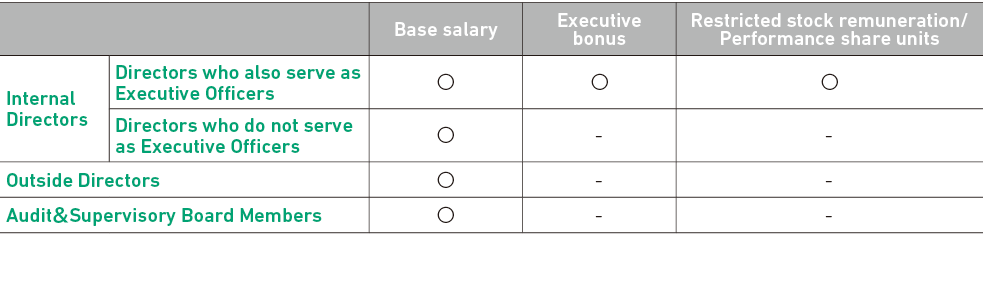
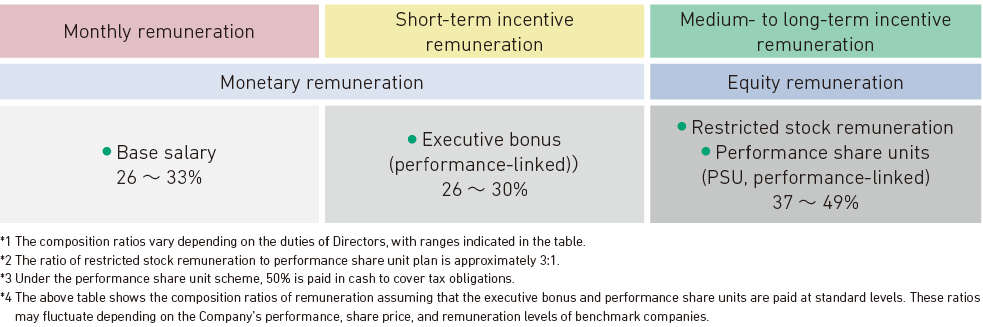
Executive remuneration consists of (1) a monthly “base salary” and (2) an “executive bonus” linked to the Company’s business performance for a fiscal year, as well as (3) “restricted stock remuneration” and (4) “performance share units,” both of which are linked to corporate value over the medium- to long-term.
The Company introduced restricted stock remuneration and performance share units in 2020 to strengthen initiatives that contribute to increasing corporate value over the medium- to long-term and to further align interests with shareholders.
The composition and components of executive remuneration are as follows.
Internal Directors who also serve as Executive Officers
For Directors who also serve as Executive Officers, remuneration consists of “base salary,” “executive bonus,” “restricted stock remuneration,” and “performance share units,” as they are expected to achieve performance targets through day-to-day business execution.
Internal Directors who do not serve as Executive Officers
Internal Directors and non-executive officers receive remuneration that consists solely of base salary and excludes performance-linked remuneration, as they are responsible for determining overall management strategies to enhance corporate value and for fulfilling oversight functions, including monitoring the execution of medium- to long-term growth strategies.
Outside Directors
Remuneration for Outside Directors consists solely of base salary and does not include performance-linked remuneration to ensure their independence. In addition, an Outside Director who serves as Chair of the Advisory Panel on Nomination and Compensation receives remuneration at a level that includes an additional amount reflecting the responsibilities of the Chair, on top of the standard remuneration level for Outside Directors.
Audit & Supervisory Board Members
Remuneration for Audit & Supervisory Board Members consists solely of base salary, in view of their primary responsibility for conducting compliance audits.
Components of executive remuneration
Base salary
Executives are remunerated with a monthly base salary as per their responsibilities.
They are individually evaluated for achievement of their performance targets, from the viewpoint of motivating them to achieve performance targets through execution of their duties and actions that lead to the Company’s sustainable profit growth. Performance targets are set through interviews with the CEO at the beginning of the fiscal year and evaluated at the end of the fiscal year. The base salary for the following fiscal year is set within a certain range reflecting the individual performance evaluations. However, an individual performance evaluation is not applicable for the CEO.
Executive bonus
The executive bonus is paid to Directors who also serve as Executive Officers as monetary remuneration reflecting performance for a single fiscal year.
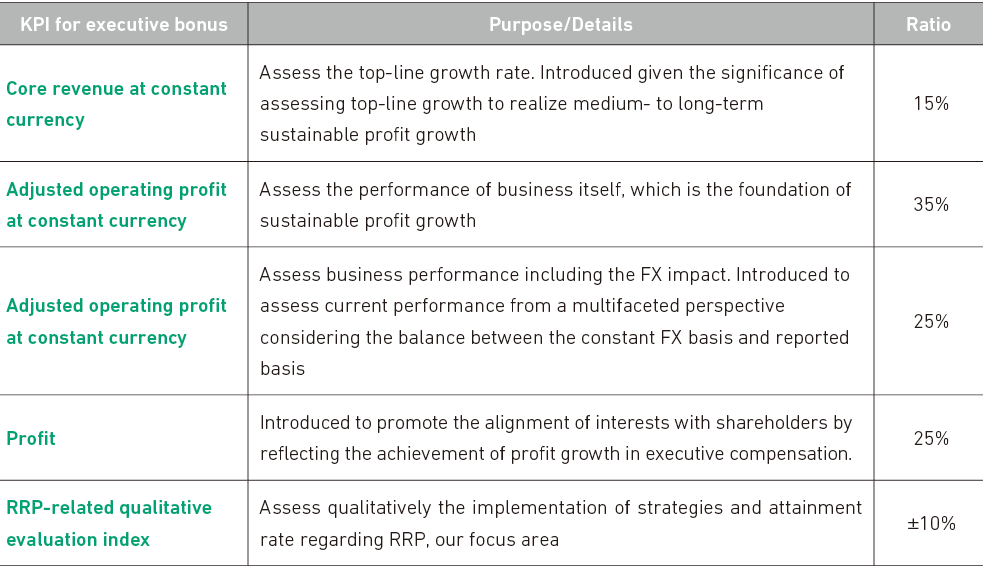
Core revenue at constant FX, adjusted operating profit (AOP) at constant FX, adjusted operating profit on a reported basis, profit for the period, and an RRP-related qualitative evaluation index* are used as key performance indicators (KPIs) for the calculation of executive bonuses. These indicators are selected from the perspective of sharing with shareholders the performance of the business, which forms the foundation of sustainable profit growth, as well as the achievement of profit growth, and of setting indicators conducive to sustainable growth over the medium- to long-term.
In calculating executive bonuses, the weighting is set at 15% for core revenue at constant FX, 35% for AOP at constant FX, 25% for AOP, and 25% for profit for the period. Consequently, performance results that include FX effects (adjusted operating profit and profit for the period) account for 50% of the overall weighting.
The payout rate varies within a range of 0% to 190% depending on the degree of achievement of these indicators, with an adjustment of -10%, 0%, or +10% applied based on the evaluation of the RRP-related qualitative evaluation index.
If a Director eligible for an executive bonus engages in certain misconduct, a portion of the bonus already paid shall be returned to the Company.
*1Core revenue is the sum of revenues in the processed food business and other businesses, as well as the core revenue in the tobacco business.
*2Constant FX is the deduction of currency effects converted and calculated using the exchange rate for the same period of the previous year from the Company’s tobacco product sales and profits or adjusted operating profit in the tobacco business for the current fiscal year. Results at constant FX also exclude any increase in revenue or profit due to inflation in certain markets, calculated using a specified methodology.
*3Adjusted operating profit is calculated by totaling operating profit, the amortization cost of acquired intangibles arising from business acquisitions, and adjustment items (income and costs). Adjustment items (income and costs) are impairment losses on goodwill, restructuring income and costs, and other items.
*4RRP stands for “Reduced-Risk Products,” which are products with the potential to reduce the risks associated with smoking such as Heated Products, E-Vapor and others. The RRP-related index is a qualitative index that captures the degree of enactment of strategies and achievement pertaining to RRP, a key field of focus.
Restricted stock remuneration
The restricted stock remuneration plan is designed to further enhance the shared value over the medium- to long-term between the Directors who also serve as Executive Officers (“eligible Directors”) and the shareholders. Eligible Directors receive monetary compensation claims every fiscal year towards restricted shares and the allocation of the Company’s common shares by paying all of the monetary compensation claims in kind in accordance with the resolution of the Board of Directors (the allotment is made from the treasury shares).
In connection with the disposal of the Company’s common shares under this plan, a restricted stock allocation agreement shall be entered into between the Company and each eligible Director.
The monetary compensation towards the purchase of the Company’s restricted stock is decided based on the closing price of the Company’s shares at the Tokyo Stock Exchange as of the previous business day of the resolution by the Board of Directors. However, if the Company’s shares do not trade at the Tokyo Stock Exchange on the day prior to the resolution of the Board of Directors, the closing price of the immediately preceding trading day is used. This share price is decided by the Board of Directors within a scope that is not particularly advantageous to the eligible Directors who receive the restricted stock.
In addition, the monetary compensation claims are granted on the condition that each eligible Director agrees to the in-kind contribution and enters into a restricted stock allocation agreement.
Although the restriction period is 30 years, in cases where any eligible Director retires for reasons other than dismissal from a position as Director or any other position separately specified by the Board of Directors during the restriction period, the transfer restrictions are removed on all of the allotted shares that the eligible director owns.
Furthermore, upon the date of payment, in cases where an eligible individual has already lost all positions as Director, Audit & Supervisory Board Member, and Executive Officer for reasons other than dismissal, the transfer restrictions are removed on all of the allotted shares that the eligible individual owns as of the date of payment.
In the event that a Director who has been granted restricted stock remuneration engages in any violation of laws or otherwise falls under grounds specified by the Board of Directors during the restriction period, the Company may acquire all of such shares without compensation.
Additionally, in cases where the Company is involved in mergers or other organizational realignments during the restricted period in which the Company is the absorbed entity, restrictions may be removed on the allotted shares prior to the effective date of the organizational realignment by resolution of the Company’s Board of Directors.
Performance share units (PSU)
Performance share unit plan is a performance-linked stock compensation system that aims to strengthen the shared value with shareholders, to enhance the Company’s value over the medium-to long-term and to commit to achieving business results over the medium term. Performance share unit plan offers monetary remuneration claims and cash to the Directors who also serve as Executive Officers after the completion of three-year performance evaluation period*1 commencing from the applicable fiscal year.
Compensation will be paid in the form of monetary claims and cash payments for issuance of the Company’s common stock based on the degree to which numerical targets, such as business performance, are reached during a given performance evaluation period. The attainment rates of numeric targets including earnings are determined following a review by the Advisory Panel on Nomination and Compensation. As a general rule, eligible directors receive the cash and monetary claims after the end of each performance evaluation period.
Eligible Directors receive the allotment of the Company’s common shares by payment of all of the monetary remuneration claims in kind (the allotment is made from the treasury shares).
The monetary compensation towards the purchase of the Company’s common shares is decided based on the closing price of the Company’s common shares at the Tokyo Stock Exchange as of the previous business day of the resolution by the Board of Directors. However, if the Company’s common shares do not trade at the Tokyo Stock Exchange on the day prior to the resolution of the Board of Directors, the closing price of the immediately preceding trading day is used. This share price is decided by the Board of Directors within a scope that is not particularly advantageous to the eligible Directors who receive the performance share units. Eligible Directors receive cash and monetary claims towards the purchase of the Company’s common shares depending on degree of achievement of the aforementioned targets. Therefore, the eligibility nor the amount of remuneration, including the number of shares, for the Directors to receive the cash and monetary claims are undecided until the performance evaluation period has ended.
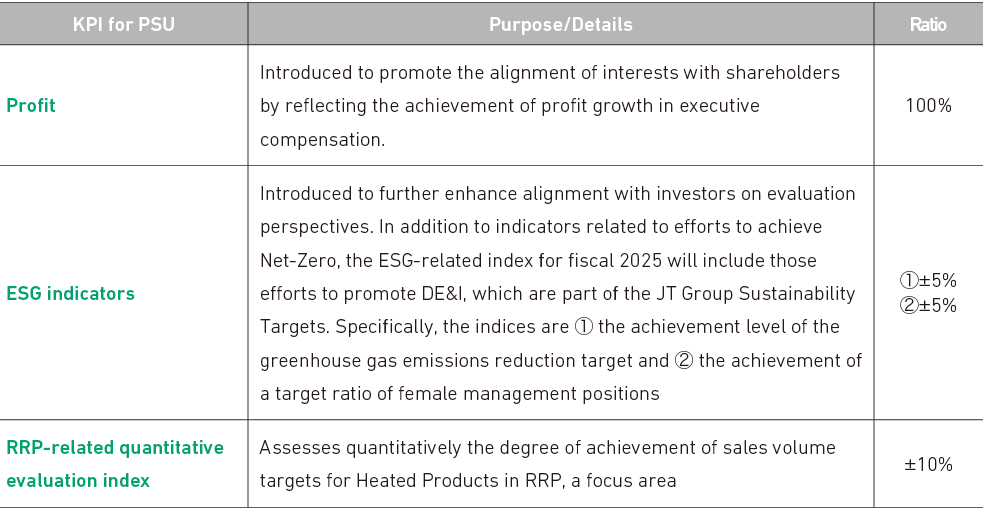
The Company determines necessary indices to calculate the number of shares given to the eligible Directors including each numeric target used in this compensation system and performance-linked factors following a review by the Advisory Panel on Nomination and Compensation. Profit (attributable to the owners of the parent company) has been set as a performance share unit plan KPI for the evaluation periods starting in fiscal year 2021, in order to share value with its shareholders. For the evaluation period starting in fiscal year 2022, in order to further align evaluation perspectives between the Company and its shareholders, ESG indicators were newly introduced in addition to profit for the period as evaluation metrics. The same evaluation metrics will apply to performance evaluation periods beginning in fiscal years 2023, 2024, and 2025.
In the performance evaluation periods starting in fiscal years 2022, 2023, and 2024, the ESG indicators are metrics related to initiatives aimed at achieving net zero; specifically, the degree of achievement of greenhouse gas emissions reduction targets is used as the evaluation item. In addition to indices related to efforts to achieve net zero, the ESG indicators for fiscal year 2025 will include those efforts to promote DE&I, which are part of the JT Group Sustainability Targets. In particular, the JT Group will use the achievement of a target ratio of female management positions to evaluate this. Further, for the evaluation period starting in fiscal year 2025, the Company has decided to introduce an RRP-related quantitative evaluation index*2 in addition to profit and ESG indicators. The aim is to promote shared shareholder value by achieving medium-term performance targets and contributing to improved corporate value. Regarding the payout structure, for evaluation periods starting in fiscal years 2022, 2023 and 2024, performance-linked payouts range from 0% to 190% based on KPI (i.e., profit) achievement, with an adjustment of -10%, 0% or +10% applied depending on the evaluation of ESG indicators. For the evaluation period starting in fiscal year 2025, performance-linked payouts will range from 0% and 180% based on KPI (i.e., profit) achievement, with an adjustment of -5%, 0%, or +5% applied depending on the level of achievement of greenhouse gas emission reduction targets among the ESG indicators. Depending on the achievement level of the JT Group’s target ratio of female management positions, an adjustment of -5%, 0%, or +5% will be applied, and depending on the level of achievement of the RRP-related quantitative evaluation index, an adjustment of -10%, 0% or +10% will be applied.
In the event that a Director is found to have violated laws or to fall under other grounds specified by the Board of Directors during the performance evaluation period, the Director may forfeit all or part of the monetary remuneration and cash scheduled to be granted.
The Company abolished the stock option plan in fiscal 2020, except for the stock option already granted, and does not issue new stock option grants thereafter.
*1The performance evaluation period for 2022 is the three-year period from fiscal year 2022 to the end of fiscal year 2024. The performance evaluation period for 2023 is effective for three years starting from fiscal year 2023 until the end of fiscal year 2025. The performance evaluation period for 2024 is the three-year period from fiscal year 2024 to the end of fiscal year 2026, and the performance evaluation period for 2025 is the three-year period from fiscal year 2025 to the end of fiscal year 2027. From fiscal year 2026 onwards, within the remuneration limit approved at the Annual General Meetings, the Company plans to offer performance-linked performance share unit plans to Directors who also serve as Executive Officers, with each fiscal year serving as the applicable fiscal year and the three consecutive fiscal years from that year constituting a new performance evaluation period.
*2This is a quantitative evaluation index related to the degree of achievement of sales volume targets for Heated Products in RRP, one of the Company’s focus areas.
Maximum amount of executive remuneration
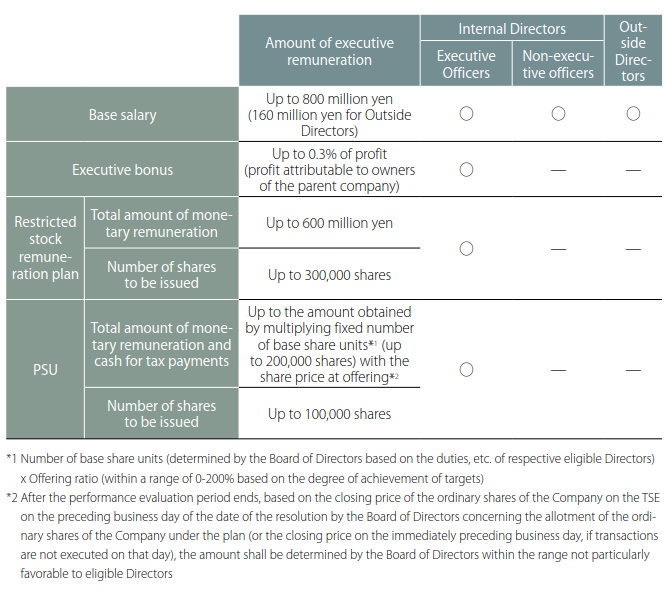
The maximum total amount of executive remuneration for all Directors is as follows. The Company’s Audit & Supervisory Board Members are eligible only for base salary and the maximum total amount of remuneration is set at 240 million yen per annum. All of these maximum amounts have been approved at the Annual General Meeting.
Systems for Supporting the Effectiveness of the Corporate Governance Structure
We have put in place internal control systems involving compliance, risk management, and internal audits for the purpose of supporting the effectiveness of the corporate governance structure, which is led by the Board of Directors. We will continue to periodically revise these existing systems on an ongoing basis in an effort to maintain and enhance the corporate structure for the appropriate execution of business.
Compliance system
Basic concept
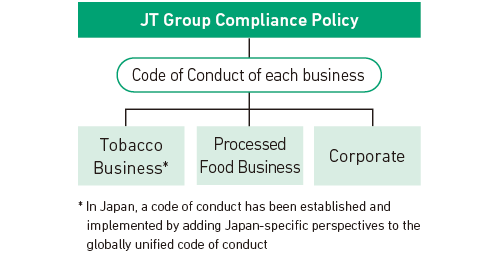
Based on the regulations established by the Board of Directors, we have formulated the JT Group Compliance Policy, which defines the globally shared values and ethics of the JT Group, to ensure that Directors and employees act appropriately and comply with laws and regulations, the Articles of Incorporation, and social norms.
Accordingly, we have also established business unit compliance codes of conduct for each corporate and business division. These codes of conduct are aligned with the JT Group Compliance Policy and adapted to their unique environments and characteristics to ensure thorough compliance throughout the Group.
Promotion and supervisory systems
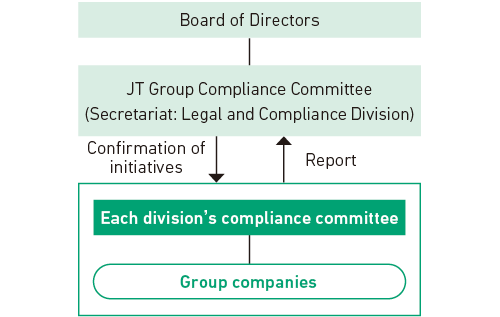
The Company has established the JT Group Compliance Committee, which consists of the CEO, Executive Vice Presidents, and external experts.
This Committee oversees and promotes compliance across the JT Group as a whole and plays the role of a deliberative body that ensures accountability to the Board of Directors. The CEO serves as committee chair.
The Company appoints an Executive Officer in charge of compliance who oversees the Legal and Compliance Division, thereby striving to establish/promote a crossover system on a Group-wide basis as well as to grasp the issues. Furthermore, the divisional compliance committees established within each corporate and business division autonomously deliberate on compliance-related matters for their respective divisions.
The JT Group Compliance Committee, meanwhile, receives reports from each divisional compliance committee, and reports the details of these to the Board of Directors after grasping and deliberating on the status of JT Group-wide initiatives.
Compliance practice and improvement
In fiscal 2025, two JT Group Compliance Committee meetings were held to deliberate on initiatives aimed at promoting compliance and other matters. The results of these deliberations were reflected in the compliance action plan for fiscal 2026 formulated by each department.
The compliance promotion departments of the Company and its subsidiaries (namely, the Legal and Compliance Division in the Company, and corresponding departments in subsidiaries) distribute divisional compliance codes of conduct to the Directors and employees of the Company. The compliance promotion departments also conduct educational and awareness-raising activities through training and other programs in an effort to enhance the effectiveness of compliance.
Compliance survey implementation
We conduct a Group-wide compliance survey annually. The survey response rate for fiscal 2025 was 96.5%. The results of the survey are reported to Directors and employees, and the relevant departments use these results to evaluate compliance initiatives and to formulate and implement improvement measures.
Internal reporting system (whistleblower system)
Group companies have set up hotlines for Directors and employees and other parties to report acts suspected of being legal/regulatory violations and other such concerns. Compliance promotion departments that receive a report or query via their hotlines investigate its details and then take action, including recurrence prevention measures, as needed. Additionally, we have set up another hotline apart from the one staffed by the Legal and Compliance Division.
The second hotline is independent of organizational units involved in operational execution and staffed by Audit & Supervisory Board Members, who investigate the details of any reports or queries received via the hotline. JT then takes action, including recurrence prevention measures, as needed, and refers or reports serious problems involving the JT Group to the divisional compliance committees and the JT Group Compliance Committee for further review as needed.
Compliance consultation・reporting hotline guide
Risk management system
For details of the JT Group's risk management system, please refer to the "Risk Management" page.
Information security
We have established information security regulations to clearly demonstrate our commitment to information security and comprehensively promote information security measures on an ongoing basis. Specifically, we have adopted the JT Group IT Governance Policy and JT Group Information Security Standards and mandated and implemented the required IT risk mitigation measures, including access restrictions, antivirus defenses, education, audits, and monitoring. We strive to manage and safeguard our IT systems, data and other information assets in an appropriate manner. We are continuously pursuing initiatives to strengthen our information security with respect to both hardware and software.
Hardware-wise, we continually test and improve our key IT systems’ security-related technologies and operations, including requests to suppliers. Software-wise, we conduct the i-SECURE information security educational program, which was developed by the Company on a global basis to promote proper handling of information assets by all employees. Among the multiple options offered through i-SECURE, 96% of all JT Group company employees attended e-learning programs. The i-SECURE program’s effectiveness is regularly measured. Indications are that it is instrumental in raising awareness of information security among employees.
Scenes from the i-SECURE event held in Japan
Internal auditing
Company internal audits
Set up to be independent of organizational units involved in operational execution and reporting directly to the CEO, JT’s Internal Audit Division seeks to enhance the adequacy and effectiveness of business management by examining and assessing controlling/operating systems that relate to all business activities, as well as the status of business execution, from an objective standpoint. To fulfill its responsibilities, the Company’s Internal Audit Division has unrestricted authority to observe all activities, inspect all records, and question all personnel on a Group-wide basis.
Annual internal audit plans are subject to the CEO’s approval. The head of the Internal Audit Division mandatorily reports internal audit results to the CEO, and reports to the Board of Directors annually. The head of this Division may freely and regularly confer with the CEO and our subsidiaries’ senior-most executives about internal audit findings, internal control statuses and risk assessments.
Group subsidiary internal audits
Our subsidiaries may set up internal auditing organizations at their own discretion. Those that have done so include major subsidiaries JTI, TS Network, and TableMark. Subsidiaries’ internal audit plans are approved by, and their audit results are reported to, their respective presidents or the Board of Directors.
The Company’s Internal Audit Division coordinates internal audits with subsidiaries’ internal auditing organizations. Subsidiaries’ annual internal audit plans and their internal audit results are reported to the CEO and our Board of Directors through our Internal Audit Division. To increase the efficiency and effectiveness of internal audits, we periodically hold meetings to improve audit quality through information sharing among internal auditing staff across the Group. We also conduct joint audits with and provide auditing assistance to subsidiaries as necessary.
Internal control system for JTI as the operator of the tobacco business
Executives of JT International Holding B.V., which serves as the holding company for JTI, also include JT’s executive officers and others, who play a role in enhancing the effectiveness of strategic decision-making across the entire tobacco business.
In addition, important decision-making authority and approval procedures related to the tobacco business, including JTI, are stipulated in the authority regulations and other relevant policies. Although a certain degree of authority is delegated to JTI to ensure the agility of business operations, the Group strives to secure subsidiary governance by requiring the Company’s approval for matters such as budgets and management plans formulated by JTI, as well as investment deals exceeding a certain amount.
In addition, the Company’s Audit & Supervisory Board Members and the Internal Audit Division have the right to audit JTI. Accordingly, Audit & Supervisory Board Members conduct audits of JTI as appropriate. JTI’s Internal Audit Division is the primary party responsible for conducting internal audits for the tobacco business, while JT’s Internal Audit Division works closely with JTI’s Internal Audit Division to conduct audits in areas of operations where the Company and JTI are working together.