Tobacco business
The global nicotine industry continues to evolve under tightening regulations and shifting consumer preferences. Governments in many markets are strengthening product standards, marketing restrictions, and taxation in response to public health concerns, while taking a range of approaches with respect to products that have the potential to reduce harm.
Shaped by these regulatory and consumer trends, the industry is experiencing a structural shift and now consists of two product categories: combustible products*1, which remain the largest segment but face steady volume pressure, and potentially reduced risk products (RRP)*2 that are expanding as innovation progresses and more consumers seek alternatives to smoking.
Evolving consumer preference has prompted global tobacco companies, including the JT Group, to expand their portfolio across Combustibles and RRP.
In Combustibles, while volume decline and down-trading are assumed to remain, industry value is expected to continue growing in the foreseeable future.
In RRP, both industry volume and value are projected to grow across all categories—Heated Products, E-Vapor and Modern Oral—while competition is expected to further intensify. The categories’ growth pace will ultimately depend on innovation, consumer acceptance, regulation and taxation.
Notes:
- The word consumers used in the context of the tobacco business means adult consumers. Minimum legal age for smoking varies in accordance with the legislation in each country
- This section is intended only to explain the business operations of the JT Group, not to promote sales of tobacco or nicotine containing products or encourage smoking or using nicotine containing products


For more details on our approach to responsible marketing, please refer to Our global marketing principles.
In the following four strategic focus areas, we cover our approach to sustainability across our tobacco business.
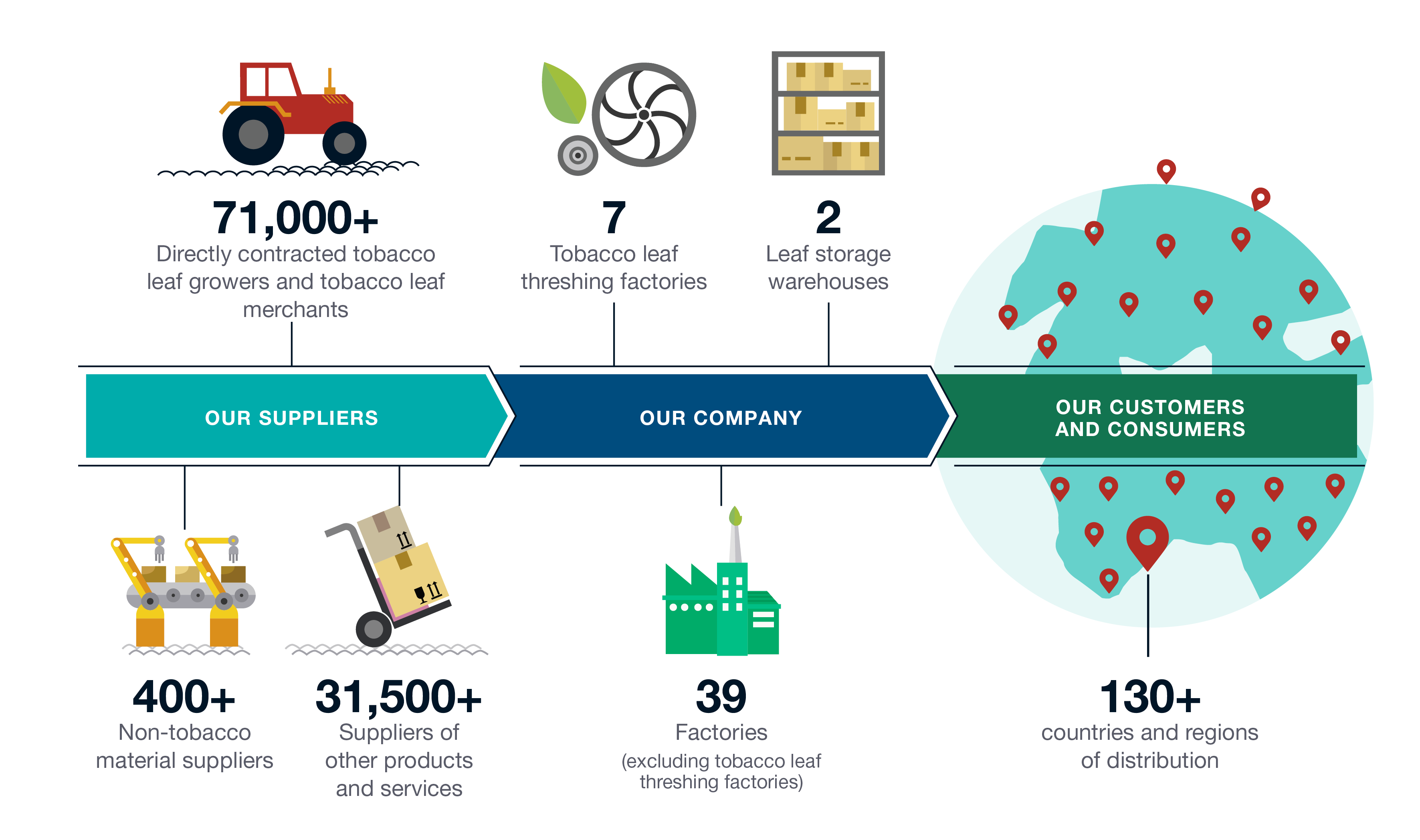
Our tobacco business value chain
The four strategic focus areas of our sustainability strategy



- *1 Combustible products: Combustible products include cigarettes, fine cut tobacco (FCT), pipes, cigars, cigarillos, and waterpipe tobacco. Cigarettes contain pre rolled tobacco, while FCT products enable adult consumers to roll or make their own cigarettes.
- *2 Reduced-Risk Products (RRP): RRP includes Heated Products, Infused Tobacco, E-Vapor, Modern Oral and Traditional Oral. These products deliver nicotine without combustion and therefore have the potential to reduce risks associated with smoking.
- Combustible products : Combustible products include cigarettes, fine cut tobacco (FCT), pipes, cigars, cigarillos, and waterpipe tobacco. Cigarettes contain pre rolled tobacco, while FCT products enable adult consumers to roll or make their own cigarettes.
- Reduced-Risk Products (RRP) : Reduced-Risk Products (RRP) includes Heated Products, Infused Tobacco, E-Vapor, Modern Oral and Traditional Oral. These products deliver nicotine without combustion and therefore have the potential to reduce risks associated with smoking.
- Adult Consumers : Minimum legal age for smoking varies in accordance with the legislation in each country.
- Tobacco Business Value Chain : We have established a global supply chain that works with more than 71,000 directly contracted tobacco leaf growers and tobacco leaf merchants, producing products through 7 tobacco leaf threshing factories, 2 leaf storage warehouses, and 39 factories, and distributing them to more than 130 countries and regions.