Tobacco Business
Business Purpose
Creating fulfilling moments. Creating a better future.
Industry overview
The global nicotine industry continues to evolve under tightening regulations and shifting consumer preferences. Governments in many markets are strengthening product standards, marketing restrictions, and taxation in response to public health concerns, while taking a range of approaches with respect to products that have the potential to reduce harm.
Shaped by these regulatory and consumer trends, the industry is experiencing a structural shift and now consists of two product categories: combustible products, which remain the largest segment but face steady volume pressure, and potentially reduced risk products (RRP) that are expanding as innovation progresses and more consumers seek alternatives to smoking.
Combustibles
Combustible products include cigarettes, fine cut tobacco (FCT), pipes, cigars, cigarillos, and waterpipe tobacco. Cigarettes contain pre rolled tobacco, while FCT products enable adult consumers to roll or make their own cigarettes.
In 2025, the global Combustibles market totaled around 5.0 trillion stick* equivalent units, with an estimated value of approximately 131 trillion yen*. China is the largest market, accounting for over 45% of global volume, followed by Indonesia, Russia, the U.S., Turkey, Germany, Japan, and Egypt. Although global Combustibles volume continues to decline at historical rates, the category's overall value has been steadily increasing driven by price increases.
RRP
RRP includes Heated Products, Infused Tobacco, E-Vapor, Modern Oral and Traditional Oral. These products deliver nicotine without combustion and therefore have the potential to reduce risks associated with smoking.
Heated Products consist of heated tobacco sticks (HTS) and heated nicotine sticks (HNS), which generate a nicotine-containing aerosol by heating a tobacco stick or a stick without tobacco leaves, using an electronic device in which the stick is inserted.
Infused Tobacco (Infused), produces a tobacco enriched vapor through indirect heating of a tobacco capsule, fitted on an electronic device.
E-Vapor products heat a nicotine-containing liquid instead of tobacco leaves using a battery-powered device and are available in formats such as open systems, closed pods, and disposables.
Modern Oral and Traditional Oral are typically delivered in small closed pouches placed between the lip and gum. Modern Oral, also known as nicotine pouch, delivers nicotine without the presence of any tobacco leaf. Traditional Oral, usually referred to as snus, delivers nicotine and contains tobacco leaf.
In 2025, the global RRP industry was valued at approximately 13 trillion yen*. Japan is the largest market for Heated Products while the U.S. leads in E-Vapor and oral products. The most popular RRP format varies by market depending on consumer preferences and regulations. Although smaller than Combustibles, the RRP category has grown steadily in recent years, and this growth is expected to continue.
Our view of the future
Evolving consumer preference has prompted global tobacco companies, including the JT Group, to expand their portfolio across Combustibles and RRP.
In Combustibles, while volume decline and down-trading are assumed to remain, industry value is expected to continue growing in the foreseeable future.
In RRP, both industry volume and value are projected to grow across all categories̶Heated Products, E-Vapor and Modern Oral̶while competition is expected to further intensify. The categories' growth pace will ultimately depend on innovation, consumer acceptance, regulation and taxation.
Our business overview
The JT Group sells tobacco products in more than 130 markets. We view our brands as one of our greatest assets and continue to make proactive investments, to grow profit in the mid- to long term.
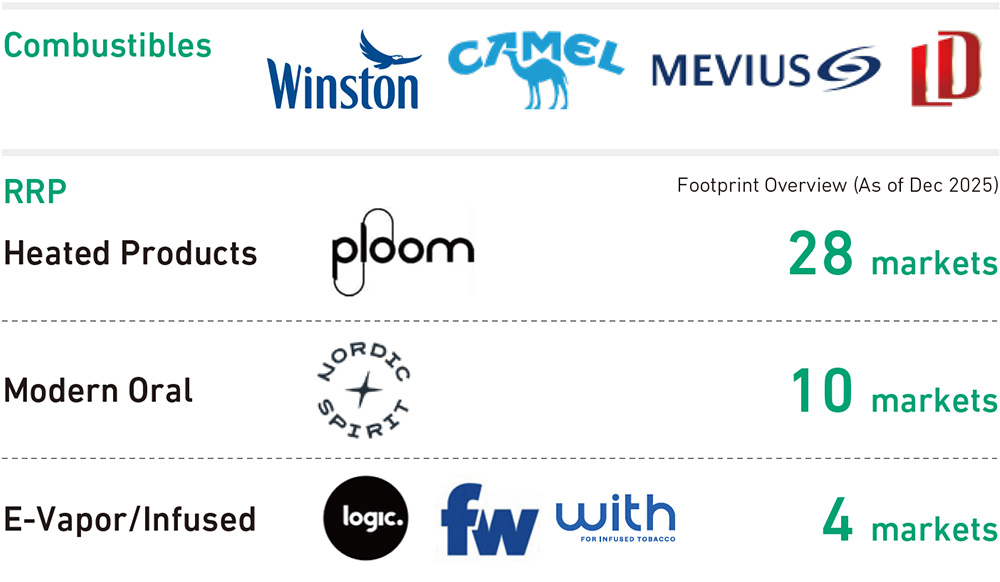
We own a wide range of brands that meet diverse consumer needs across global markets. Among our portfolio, our Global Flagship Brands (GFB)̶Winston, Camel, MEVIUS, and LD̶are among the world's most recognized brands and form the core of our brand lineup that enhances our competitiveness and enables us to effectively expand our global presence in Combustibles.
Our portfolio combines the rich heritage of Combustibles with cutting-edge technical and scientific innovations in RRP. We are present in Heated Products with our brand Ploom. Similarly, we have dedicated brands in other RRP categories: Modern oral, E-Vapor and Infused.
Business strategy̶Business Plan 2026
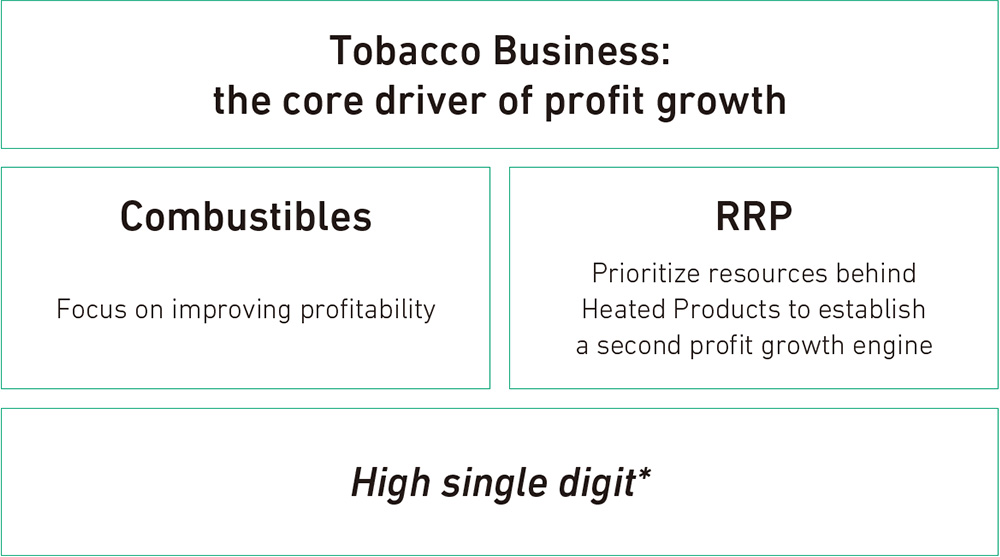
As outlined in our Business Plan 2026, our strategic direction remains unchanged. In Combustibles, we will further improve profitability. And in RRP, we will concentrate our business resources toward Heated Products to establish, in the medium to long term, a second profit growth engine alongside Combustibles. As a result, we aim to grow AOP at high single-digit CAGR over the plan period.
RRP
Our view remains that Heated Products are expected to grow the most within RRP in the future.
We will therefore continue to prioritize investments in Heated Products within RRP, accelerating our growth momentum through large-scale strategic investments.
In other RRP categories, including Modern Oral, E-Vapor and Infused, we will continue to profitably explore business opportunities and make selective investments tailored to each category.
At the same time, we will continue to advance initiatives to strengthen our pipeline of Next Generation Propositions that may not necessarily fall within the existing RRP categories, with the aim of creating offerings that could serve as future growth drivers for our RRP business.
Combustibles
Although industry volumes in Combustibles continue to decline at historical rates, the category remains resilient and a large consumer segment.
The Group will continue to pursue quality top-line growth by capitalizing on pricing opportunities across our markets and by driving further market share expansion.
We will also continue to improve profitability through targeted investments aligned with our market archetypes̶earnings only, share only, earnings & share̶and through initiatives to manage ongoing inflationary pressure on our cost base. These efforts will generate additional returns, enabling us to improve our Combustibles operating margin and fund investment in RRP.
Performance in recent years
The JT Group's tobacco business has delivered outstanding performance over the last five years, showcasing the robustness of our strategy.
We have grown total volume for the third consecutive year, clearly outperforming industry volume trends.
In Combustibles, our volume grew by 1.7% year on year in 2025. Our organic volume increased in more than 50 markets, further supported by the successful integration of the Vector Group Ltd.. GFB volume grew for the seventh consecutive year and continued to drive share gains. By the end of 2025, GFBs represented 74% of our Combustibles volume.
Our RRP volume grew by more than 20% year on year in 2025. Heated Products were instrumental to the growth, with volume increasing by close to 40%. Ploom continued to demonstrate robust share growth across our markets, including in Japan where AURA, which we launched mid-2025, clearly contributed to the acceleration of Ploom share gains.
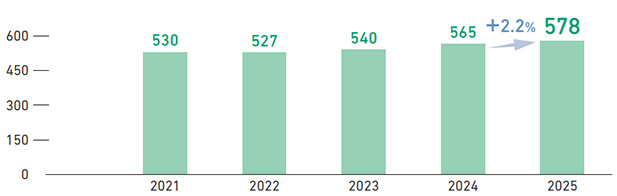
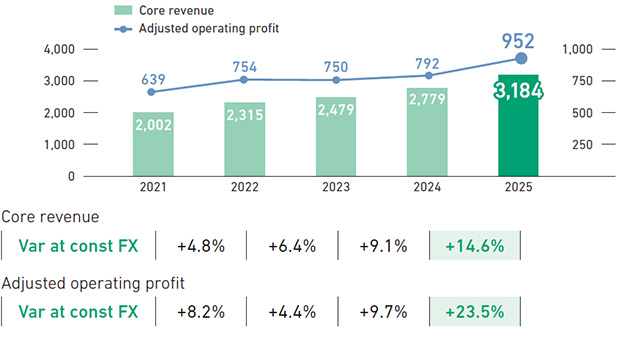
GFB and Ploom volume growth, together with solid pricing and increased focus on return-on-investment, enabled the tobacco business to consistently grow core revenue and adjusted operating profit at constant currency over the last five years.
Total shipment volume (BnU)
Core revenue and adjusted operating profit (JPY BN)
Sustainability highlights
Our sustainability focus and approach
In 2025, we advanced our sustainability strategy by focusing on innovative product design and nature protection across our value chain.
In line with JTI's Sustainability Impact Framework, designing for circularity and reducing health impact remain our core strategic priorities for the Product pillar. We continue focusing on embedding circular principles into product and packaging design from the outset and ensuring our solutions continue to meet evolving consumer expectations. We also initiated activities to implement EU Packaging and Packaging Waste Regulation requirements in a timely and effective manner.
Under the People pillar, we advanced our people-first approach by strengthening our due diligence across high-risk operations, with a focus on salient issues such as child labor and living income, while continuing to foster a supportive, inclusive and high-performing workplace recognized through our Global Top Employer certification. We strengthened the implementation of human rights action plans, with 24 of 31 plans closed, contributing to risk reduction in priority locations and accelerated implementation of mature programs like ARISE. Our efforts position us as a leader in human rights, with external recognitions including inclusion in International Organisation of Employers guidance and a top global ranking in the HACE benchmark for child labor risk management.
In 2025, we further advanced our sustainability agenda by strengthening our strategic approach to nature across the value chain. The launch of JTI's Nature Framework established a structured, company-wide approach to managing nature-related impacts, dependencies, risks and opportunities, covering land use, biodiversity, water and waste. Guided by JTI's Sustainability Impact Framework and informed by learnings from the climate program, the JTI Nature Framework and associated strategy provide a clear foundation for integrating nature considerations into business decision making. The JTI Biodiversity and No Deforestation Ambition Statement outlines the strategic direction and articulates JTI's long-term commitment to protecting biodiversity and preventing deforestation. The approach is aligned with leading international frameworks and evolving regulatory expectations. To support consistent implementation, we have developed the JTI Deforestation and Conversion Free Policy, which embeds clear requirements and governance across operations and supply chains. Together, these elements reflect JTI's shift toward a more holistic, coherent and forward looking approach to nature, supporting ecosystem protection and long-term business resilience.
2025 performance at a glance
Work to further operationalize our sustainability strategy delivered measurable progress across all pillars.
We have expanded the availability of RRP products, now in 36 countries and territories in 2025, up from 28 in 2024. We have also advanced our circularity efforts by introducing pre-owned Ploom AURA devices to the market in Japan with strong commitment that these devices meet the same high standards of quality and functionality as new products.
We are ahead of our target to achieve 85% packaging recyclability by 2025, reaching 92%, and remain on track to achieve 100% by 2030. When measured against the 2022 scope, we achieved 20% recycled materials across our packaging portfolio. This marks a key milestone in our sustainability strategy. By increasing absolute weight of recycled materials used in our packaging, we further advanced the reduction of virgin material use.
We are also making good progress on our social goals. The recordable injury rate per 200,000 working hours decreased by 20% versus 2024. We are moving forward with our diversity efforts, as more women are now in managerial roles, reaching 27.7% in 2025 (vs 26.8% in 2024).
Through the efforts that we have made to reduce emissions from our factories, offices and warehouses, we are currently over-achieving against our target. In addition, in 2025 we started to implement our Offsetting Strategy. As a result, we are proud to announce that we will be Carbon Neutral for our own operations in 2028, two years earlier than originally planned.
 See Details
Reducing health impact: Transparency in RRP science

The JT Group has a long history of developing propositions with the potential to reduce the health risks associated with smoking. In recent years, many adult smokers have chosen to use such products, in particular non-combustible products, which reduce exposure to known harmful substances found in tobacco smoke. Several public health bodies have endorsed such products for their reduced-risk potential, which can contribute to harm reduction.
We believe it is essential for reduced risk potential to be scientifically substantiated and findings shared transparently in order to support informed choice. Every year, we invest heavily in research to thoroughly evaluate our Reduced Risk Propositions. One exciting area we use is New Approach Methodologies (NAMs), including cutting edge Organ on a Chip (OoC) technology. These tiny, simulated "organs" allow us to study how substances behave in conditions that more closely resemble real human biology, giving us deeper, more relevant scientific insights than traditional lab tests.
One recent study we published looked at how aerosols from Heated Products compare with cigarette smoke in their effects on the early stages of atherosclerosis, a condition which happens when plaque builds up in the arteries and can lead to serious cardiovascular problems. Multiple lifestyle factors play a role, including diet, exercise, and smoking. To explore this, our scientists used an advanced OoC model, essentially a tiny, lab grown blood vessel. This allowed them to see how the cells reacted to Heated Products aerosols compared to cigarette smoke in a controlled way, especially how the immune system might respond. Overall, this approach aimed to help us better understand whether Heated Products may pose a lower risk than combustible cigarettes when it comes to early changes linked to cardiovascular diseases.
Our chip based blood vessel model let us closely observe how different tobacco products trigger inflammation, a key event in the development of atherosclerosis. Heated Products aerosols had far less impact than cigarette smoke: they weakened the vessel lining much less and attracted fewer immune cells. In fact, their effects looked similar to the untreated control conditions, suggesting Heated Products aerosols may pose a lower risk to blood vessel inflammation and the development of atherosclerosis. (Monocyte migration assay using a vascular-on-a-chip model and its utilization for the evaluation of a heated tobacco product - Hayashida et al., 2025, Frontiers in Toxicology)
These advanced lab methods can provide a useful first screen of tobacco products and their potential effects on the human body. To build a fuller picture, additional, including longer-term, studies are required to translate our laboratory insights into a clearer understanding of real world consumer health impacts.
We have a clear commitment to transparently evaluate the reduced risk potential of RRPs and we share the findings of our scientific studies openly, presenting them at scientific conferences and in peer-reviewed journals.
Our approach to RRP sourcing
We have a dedicated RRP sourcing team specialized in sourcing RRP devices manufactured by contract manufacturing organizations. Our approach to responsible sourcing is aligned with the OECD Guidelines for Multinational Enterprises and the UN Guiding Principles on Business and Human Rights. To better identify and assess supply chain risks, we use a risk-based due diligence approach. We consider risks inherent to electronic manufacturing and raw materials sourcing, as well as the specific human rights and environmental risks related to each supplier and the countries where they operate. We collaborate with suppliers to strengthen their capabilities and help them continuously improve their sustainability performance.
As a member of the Responsible Business Alliance (RBA), we are committed to RBA Code of Conduct and leverage their initiatives and tools to ensure the responsible manufacturing of our products. All of our existing Tier 1 and selected high-risk Tier 2 suppliers were audited under the RBA Validated Assessment Program (VAP) and received silver recognition, with audit scores exceeding the average of their respective countries. The audits typically identify issues related to working hours, health and safety, and emergency preparedness, which require close attention and are usually addressed after implementing a corrective action plan.
As stated in our Minerals Sourcing Statement, we are committed to sourcing materials responsibly, and we extend this expectation to our suppliers through our updated Supplier Standards. This commitment is supported by and aligned with the OECD Due Diligence Guidance for Responsible Supply Chains of Minerals. We leverage the Responsible Minerals Initiative tools to increase visibility deeper in our supply chain. In 2025, we expanded our due diligence scope to cover battery-contained metals and worked with our battery suppliers to ensure the minerals in our supply chain are responsibly sourced. Recognizing that certain risks are inherent at deeper levels of our supply chain, we partnered with a 3rd party platform to map our supply chain and identify potential forced labor risks beyond Tier 2. The complexity and dynamics of the electronics supply chain make this process very challenging, however, we remain committed to better understanding our supply chain and its inherent risks.
Further to the environmental topics covered through RBA audits, we launched a more detailed environmental due diligence. We work toward assessing the environmental impact of our RRP devices through a Life Cycle Assessment (LCA), with a primary focus on climate change. This allows us to identify hotspots and address our impacts in close collaboration with our suppliers.
Advancing living income through supply chain due diligence
Our Leaf Supply Chain Due Diligence (SCDD) process is built around a five-step framework̶Identify, Prioritize, Respond, Measure, and Communicate & Report̶to help ensure respect for human rights across our tobacco supply chain. Through SCDD we systematically identify and manage human-rights risks and impacts at the tobacco farm level, with a focus on continuous improvement over time.
Our materiality assessment and SCDD have identified living income for directly contracted growers as a priority human-rights topic. Addressing living income is relevant to the long-term sustainability of our supply chain and supports broader efforts to strengthen economic resilience at the farm level.
In 2025, we achieved full implementation of our Living Income Calculator across all direct tobacco leaf supply chain origins, meeting the target set in 2023. This milestone strengthened our understanding of growers' economic conditions and enabled the establishment of robust living-income baselines across origins. Building on these insights, we developed the Living Income Strategic Framework (LISF) to guide actions and drive measurable, continuous progress. The LISF aligns with our broader vision and commitments̶supporting our ambition to contribute to a better future in which growers can afford a decent standard of living. It recognizes that progress toward living income varies across regions, farm sizes, and socio-economic contexts, and is therefore designed to be data-informed, adaptive, and grounded in local realities.
Using the Living Income Calculator and annual baseline assessments, we assess potential living-income gaps across our direct supply chain. These insights help identify key drivers affecting growers' livelihoods and inform the prioritization of tailored support measures. Rather than applying uniform solutions, we tailor grower support programs to identified gaps, ensuring actions are relevant, respectful, and responsive to growers' needs and aspirations.
Our approach to reducing child labor

Since 2011, the ARISE program has worked to build a better future in grower communities by focusing on education and empowerment. Its approach to eliminating child labor combines two pillars: prevention and response. Prevention addresses root causes such as limited school access, low awareness, and economic pressure.
In parallel, ARISE is strengthening and scaling response measures through a global Child Labor Case Management System (CLCMS). Finalized in 2025, the Global CLCMS Framework and Guide provide practical, structured guidance for countries to establish, implement, and assess effective response systems tailored to local contexts.
The system ensures that identified cases receive timely and appropriate support through clear identification processes, safe immediate actions, structured referral pathways, robust governance, and systematic follow-up. Going forward, ARISE will digitalize case-management tools to enhance transparency and comparability.
Together, these prevention and response components form ARISE's hybrid model sustain long-term risk reduction while ensuring strong and accountable responses when cases occur.
Visit our website to learn more about the ARISE program and the prevention and response efforts.
Advancing net zero and nature commitments across key tobacco leaf sourcing regions
In 2025, we continued to advance our Net Zero and Nature targets across key tobacco leaf sourcing regions through a combination of productivity gains, efficiency improvements, and expanded investment in sustainable forestry. These actions support progress toward our climate and nature strategy by enabling more efficient use of inputs, reducing pressure on land, and helping mitigate deforestation risk across our supply chain. Improving agricultural productivity is central to our climate commitment, as higher yields reduce emissions intensity by increasing output per hectare and improve the efficiency of crop inputs such as fertilizers. In parallel, continued investment in curing-efficiency technologies contribute to lower emissions intensity in wood-fuel-dependent origins, while long-term forestry programs support the availability of renewable wood supply.
In Tanzania, productivity gains and curing efficiency trials demonstrated the potential of these approaches in practice. Tobacco yields increased compared with previous years, and trials of a double-combustion furnace showed significant reductions in wood consumption, supporting future emissions reduction pathways as broader deployment is considered. The country also expanded its sustainable forestry footprint through additional large-scale plantations in 2025.
In Zambia, similar productivity improvements were recorded across both flue-cured Virginia and burley tobacco. Continued upgrades to curing infrastructure supported more efficient wood-fuel use during the crop, while sustained investment in forestry initiatives reinforced the origin's long term approach to renewable wood supply.
Together, these initiatives illustrate how targeted productivity, efficiency, and forestry measures can contribute to emissions reduction efforts, strengthened nature protection, and the long term resilience of the tobacco leaf supply chain.
Integrated Report
2026