Turning change into strength through a strong financial base and commitment to sustainable growth
Through a disciplined approach to financial management cultivated over many years, the JT Group has maintained a strong financial base that enables it to respond to a wide range of changes in its business environment. Even in today's increasingly uncertain climate, the Group remains committed to conducting business operations grounded in this strong financial base, and undertakes business investments aimed at future growth without hesitation. Rather than buckle under this volatile environment, we will embrace change as an opportunity to create new strengths and work toward our next leap forward. Looking ahead, we will address the expectations of stakeholders in a bid to ensure the sustainable growth of our corporate value.
An increasingly complex environment
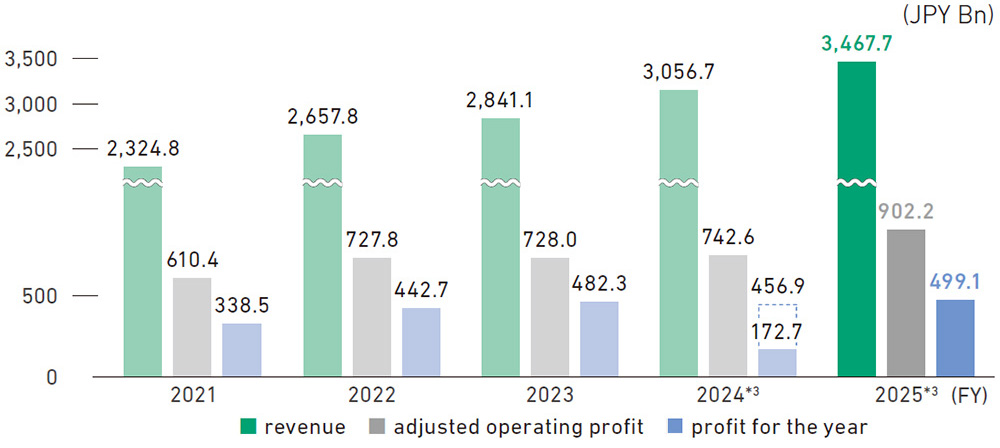
Looking back, I believe that we achieved outstanding financial results in fiscal 2025. Revenue, adjusted operating profit, operating profit, and profit for the year all reached record highs. In particular, pricing effects manifested strongly across many markets, including Japan, the Philippines, Russia, Turkey, and the U.K.
Moreover, the acquisition of U.S. company Vector Group Ltd., completed in October 2024, contributed to our performance. Similarly, the processed food business achieved higher revenues and profits, thereby contributing to the Group's results as a whole. We believe that our continue growth-oriented investments contribute to our results in fiscal 2025, reaffirming the resilience of our earnings base.
Meanwhile, looking at current conditions in my capacity as CFO, I recognize that we must remain mindful that the macroeconomic environment continues to be uncertain, influenced by a variety of factors, including growing geopolitical risk and foreign exchange fluctuations. In light of this business environment, identifying future assumptions and key risks has become more complex and challenging than ever.
Even as we find ourselves surrounded by a rapidly changing external environment, we continue to recognize the importance of building a financial structure that allows us to reliably execute business investments for the future. As CFO, it is my mission to fully maintain our financial base in a way that enables us to take any action required without being overwhelmed by uncertainty.
 See Details
Financial performance trends (revenue, adjusted operating profit, profit for the year)
Financial management in a highly uncertain environment
In this recent environment, my top priority from a financial management perspective is to continuously enhance corporate value over the medium- to long-term. We maintain an unwavering commitment to sustainable growth over the medium- to long-term, and just as we have in the past, recognize the critical need to undertake business investments for future growth. In addition, one of our key abilities is generating cash flow, which is essential to realizing business investments. Along with profit indicators, we constantly analyze and assess, from many perspectives, the degree to which we can consistently generate cash through business activities while at the same time testing whether we can appropriately control risk while maintaining a sound financial position. Regardless of how significantly the external and market environments evolve, we must avoid decisions that undermine future growth. Instead, we remain mindful of whether our decisions contribute to the sustainable creation of value.
To prepare for future uncertainty, we must also consider as many parallel scenarios as possible. Maintaining multiple scenarios will allow us to expand the available options for decision-making in accordance with conditions. In the past, we were able to forecast outcomes based on simple causalities, such as pressing one button to turn on a single light. Today, we face a world that is far more complex, where pressing one button may turn on or off three lights. Regardless of how well we prepare in advance, today is an era in which unexpected phenomena can suddenly manifest. Moreover, there are now very few situations in the realm of management decision-making where we can pass judgment with all the necessary information at hand. In other words, in addition to numerical data and trends, the times demand comprehensive judgments that fully mobilize both creativity and experience.
Which is exactly why the ability to identify the extent and quality of risks has become so important. Likewise, it is vital that we maintain a range of options, including course changes and measures to minimize risks, in the event that matters do not proceed exactly as planned. The key to financial management in an era of change is therefore options that allow us to flexibly handle any situation̶options that emerge from identifying risks to the fullest extent possible and preparing countermeasures before falling into a desperate situation.

Healthy sense of urgency that supports globalization
One of the factors behind the financial discipline that the JT Group has cultivated lies in the many challenges we have faced throughout our journey toward globalization. When I joined the Company in 1993, JT's business structure was centered primarily on the domestic market. Despite an overwhelming share in Japan at the time, amid the progress of market liberalization, including the elimination of tariffs, and against the backdrop of a decline in overall tobacco demand, there was growing public skepticism about the industry's long-term prospects. As such, we harbored a genuine sense of urgency, and felt that failing to act would mean our business would end up in a state of shrinking equilibrium.
Under these circumstances, the answer offered by the management team at that time was to turn full sail toward international markets through M&As. The acquisition of RJR Nabisco Inc.'s non-U.S. tobacco business (RJRI) in 1999 was a historic turning point for the Group. While we faced a wide range of public reactions, including criticism, at the time, at the root of our thinking stood the strong yet healthy sense of urgency that we would fail to survive as a company if we did not make this move. At the same time, under a strong resolve to leverage our own strengths and "take the leap onto the global stage," we believe this led us to decisively shift course toward significant business growth.
That said, the acquisition of RJRI did not instantly transform us into a global company, nor did it immediately enable us to accelerate growth. Instead, we initially faced a series of challenges, causing many of our employees to struggle. Overcoming those challenges and gaining a wide range of accumulated experiences and lessons led to the subsequent acquisition of U.K.-based Gallaher Group Plc, ultimately contributing to our robust management foundation of today. The employees at the time had a shared long-term perspective of creating conditions that would allow us to grow sustainably across future generations, instead of simply chasing current performance. The very source of our strength today stems from this long-term perspective.
A financial base that balances resiliency with flexibility
Buoyed by this historical background and experience, we established the basic principles of our current financial strategy. This policy seeks to balance the resiliency to weather changes in the environment with the flexibility to seize growth opportunities.
The Group's basic management principle is to pursue the 4S model, which aims to fulfill our responsibilities to our valued consumers, shareholders, employees, and the wider society. In order to embody this principle, we must, more than anything else, ensure the continuity of our business. Acutely aware of this demand during the Great East Japan Earthquake of 2011 and the COVID-19 pandemic, we also recognized that continuing to deliver products to consumers without suspending operations, regardless of whether society as a whole has fallen into turmoil, is at the core of a company's operations, which in turn demands a robust level of financial preparedness. Moreover, we strongly believe that the resilience to keep our feet firmly planted when emergencies occur is of paramount importance.
We engage in business across diverse markets in countries around the world, including emerging economies, and therefore manage our businesses under vastly different conditions in terms of market environments, regulations, and economics. In order to steadily capture growth opportunities within this environment, we must secure financial freedom to ensure business continuity even in the face of highly uncertain circumstances. On the other hand, large-scale business investments, including M&As, are indispensable to enhancing corporate value over the medium- to long-term. Such investment opportunities do not arrive at all times, making it critically important not to miss the right timing. To ensure that we do not lose valuable growth opportunities due to financial constraints when such opportunities do arise, it is equally essential to maintain financial flexibility during normal times.
We have the capability to generate stable free cash flow in the range of 400–500 billion yen annually. Although this level has not been achieved in recent years due to temporary factors such as M&A, this underlying strength supports our resilience and flexibility. By centrally managing the cash generated by each business entity at the Group level and maintaining a well-balanced approach among agile business investments, the acquisition of external resources, and shareholder returns, we achieve efficient and disciplined financial management across the Group as a whole.

Funding in preparation for unforeseen events and risk management
Although I have focused on our strong financial base, there is little meaning in simply making a static assessment that the current balance sheet is healthy. Instead, what is really in question is whether we have made the necessary preparations to enable appropriate and swift decision-making and to execute the required measures in any situation. The resilience of our financial standing is reflected in our agile funding structure as well as our risk management system designed to address changes in the external environment.
As far as financing is concerned, the key point is much more than funding at hand. It is also about the breadth and depth of options for securing funds from external sources. For this reason, we have sought to diversify our funding tools, for example by issuing corporate bonds on multiple markets and securing credit lines from financial institutions. It is crucial here to maintain close communication with funding sources on a regular basis to deepen our mutual understanding. These daily efforts underpin the ability to undertake agile investments as and when required.
Moreover, as a company that is active globally, we assume a certain degree of exchange rate fluctuation and geopolitical risk. As part of our commitment to risk management, we identify and assess risks both from quantitative and qualitative perspectives, develop strategies tailored to the short, medium, and long term, and take unfailing action.
Along with collecting and monitoring information on each market in which we operate as part of necessary scenario planning, we have committed to several other steps over different time frames in preparation for emergencies, should they arise. For the short term, we have formulated countermeasures to maintain stable supplies of products using a geographically diversified global supply chain. For the medium- to long-term, we are working to strengthen and expand our global business foundation in order to mitigate the impacts of specific markets on the Group's performance, while also expanding accessible markets in which we can generate profits on an ongoing basis.
In risk management, it is essential to continuously improve forecasting accuracy, enhance sensitivity to change, and steadily strengthen our resilience to risks. We will also proactively work to enhance our capabilities in these areas.
Resource allocation and shareholder returns
We allocate resources to forward-looking business investments on a priority basis. While the tobacco industry is subject to various regulations and faces an evolving business environment, we believe there is still ample room for our tobacco business to grow. In specific terms, we intend to continue prioritizing investments in RRP, particularly the heated products category, which will drive strong future growth.
Meanwhile, for combustibles, a pillar that generates profits for the Group as well as investment funds for the future, we will improve return on investment (ROI) through various means, including brand portfolio optimization, pricing strategies, and cost optimization. These efforts will help maintain and strengthen our platform for generating cash. Leveraging the cash generation capability of the combustibles segment, we will also strengthen shareholder returns through business growth while making ongoing, medium- to long-term investments in RRP. In addition, we will enhance the competitiveness of the processed food business as an area that complements profit growth for the Group. Similarly, we will maintain our commitment to exploring new business opportunities through D-LAB.
Delivering returns to our shareholders is one of our core responsibilities. We therefore maintain our policy of targeting a dividend payout ratio of 75% +/-5% as the standard for competitiveness on the capital markets. Although we temporarily exceeded this in fiscal 2025, this decision was made based on the strength of our financial standing and our outlook for future profit growth. In short, our basic approach to shareholder returns and allocation of management resources remains unchanged.
Trend of dividend per share(JPY)
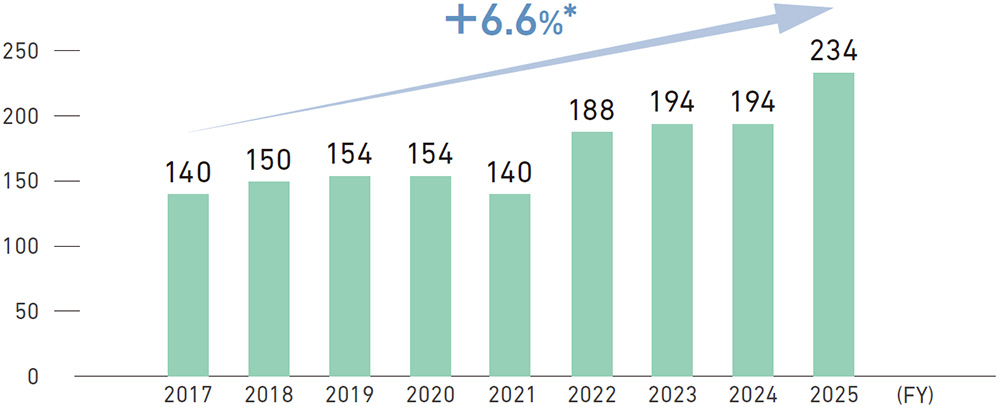
* Compound annual growth rate from 2017 to 2025
- 1. The dividend payout ratio for 2025 is 85.0%. This figure is calculated based on the profit for the year of 488.6 billion yen after the Canada Adjustment and deducting the one-time loss from the disposal of goodwill due to the liquidation of the Sudanese subsidiary.
- 2. In 2021, we revised our shareholder return policy and rebased the dividend per share.
Evaluation by the capital markets
We recognize that dialogue with investors is essential to promoting our financial strategy. Since our public listing, we have engaged in ongoing dialogue with our shareholders and investors and have developed our own approach to communication; however, this approach is not always optimal. Recognizing that market conditions and investor interests are constantly changing, we believe it is essential to maintain dialogue that is not bound by conventional frameworks in order to respond effectively. By increasing opportunities for dialogue, we aim to gain new insights and perspectives, enhance the quality of our communication, and at the same time reflect these insights in further improving our financial strategy and information disclosure. Through constructive dialogue with the capital markets, we will provide stakeholders with a deeper level of understanding regarding our approach to medium- to long-term value creation.
We also understand that investors increasingly view companies from a sustainability perspective, whether in terms of financial and business performance or ESG concerns, and we therefore intend to further enhance our disclosure accordingly.
Turning change into strength to realize sustainable growth
In closing, I would like to convey my determination as CFO to enhance corporate value. In order for the Group to achieve sustainable growth, we must maintain an unwavering commitment to operations that enable us to execute investments and make decisions without missing opportunities even amid the uncertainties and various restrictions that exist in the external environment. We must without question possess the financial base and financial discipline that serve to underpin these operations, which is why we recognize the importance of maintaining a wide range of options, including external funding.
Because a company is a living, breathing entity, we must continue to secure options even under extremely uncertain circumstances without allowing funding and resources, the lifeblood of business, to run dry regardless of the environment.
We will continue to steadily execute investments aimed at future growth. We will also drive our business forward by firmly reinforcing our financial base, appropriately taking on risks, and cultivating a broad range of business seeds that will blossom in the future. We expect to face a range of environmental changes along the way; however, by turning those changes into our own strengths, we will further enhance our resilience. Moving forward, we will realize greater corporate value for the JT Group in a sustainable manner as we live up to the trust of our stakeholders.
Fiscal 2025 results, fiscal 2026 forecasts, profit growth outlook during Business Plan 2026
RRP business strategy and progress toward future growth, Medium- to long-term growth strategy following the transfer of the pharmaceutical business, future business portfolio
Environment: Initiatives for climate change, biodiversity, and resource circularity initiatives
Social: Promoting human rights due diligence, initiatives to expand human capital, addressing issues related to smoking and health
Governance: Effectiveness of the Board of Directors, policies and initiatives on governance of Group companies
Integrated Report
2026